According to the Banana Link, "the banana and plantain family is the fourth most important staple crop in the world. Bananas and plantains are critical for food security in many tropical countries. World banana production amounts to some 70 million tonnes per year concentrated in Africa, Asia, the Caribbean and
 Latin America because of the climatic conditions." Several million people depend on bananas as a food source and to keep them alive. Many are used for export, but the largest producers, India and Brazil export very little because most are consumed by people in their own countries. Ecuador, Costa Rica, Columbia and the Philippines are among some of the largest exporters of "dollar" bananas (, with the U.S. being among the top importers. The workers work in large monoculture factories that are known to cause harm to the environment. Banana Link mentions, "these huge plantations have a significant environmental impact including soil erosion, water pollution, deforestation and a steady increase in pests and diseases that can only be fought with more harmful pesticides. Aerial spraying of pesticides contributes to water and land contamination. The colonization (sic) of large tracts of land by banana companies has often driven out indigenous populations and accelerated deforestation and soil depletion, provoking more frequent and more dramatic flooding of the land." In general, they are subjected to very poor conditions for long hours (at least 12 hours) and low wages with little job security, using large amounts of harmful chemicals. Workers are not allowed to create associations or form unions to bargain for better conditions and these regions are known to take violent means to affect such organizing. It is noted, "Ecuador, Colombia and Peru are the only countries among the major banana exporters which still have a few thousand small banana farmers alongside the large-scale plantations. The smallholders fulfill (sic) a vital buffer function for the banana exporters. They buy from small producers when the demand on the international market is high, but if less bananas are consumed on the market, they are forced to sell them well below their cost of production." The use of pesticides in these countries is 16.3 times what is used for crops in industrialized countries. Also, "Studies conducted by the National University of Heredia in Costa Rica reveal that rates of pesticide poisonings are three times higher in the banana regions than in the rest of the country. They also show that cases of sterility and cancers are more and more frequent among workers." Not to mention that the
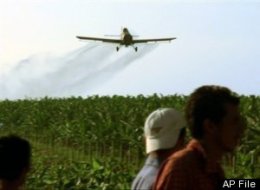 ir children play in these areas since many families live near or on the plantations, causing problems for the whole family, not just the workers. The plantations are controlled by five major companies, creating the bottleneck of the banana industry and a race to the bottom. It is claimed, "because of their size, the companies are very powerful both in exporting countries and in their country of origin. Today, they set producer countries competing with each other, pressuring governments to accept favourable policies on corporate taxation, export taxes, preferential access to loans, and deregulation of social and environmental policies." Making any threat of taking business to another region that will not complain or ask for better conditions a big advantage in keeping workers quiet and compliant, since they are seen as disposable. Banana Link states, "supermarkets are now the only players in the banana chain to consistently make profits from bananas, having dramatically increased their economic power in the banana chain in the last decade. Bananas are the single most profitable item passing through the c
 heck-outs in British supermarkets, accounting for 1% of all sales. In the USA, it is estimated that bananas represent 2% of the total turnover of North American grocery retailers; in Britain, it is probably more than this." After they reach this point, the image of the supermarket helps to make them look like the "good guy," because they are the ones that are trying to keep the prices low, compared to their competition, for the consumer. Even though this is only in their self-interest. In the conclusion of Patel's stuffed and Starved he states, "unless you're a corporate food executive, the food system isn't working for you. Around the world, farmers and farmworkers are dying, with the connivance of elected officials, and at the whim of the market. Though processed food, consumers are engorged and intoxicated. The agribusiness's food and marketing have contributed to record levels of diet-related disease, harming us today and planting a time-bomb in the bodies of children around the world. Supermarket shelves offer an abundance of cheap calories, even as they bleed local economies. We are increasingly disconnected both from the production of our food and from the joy of eating it. Most of this happens with consumers ignorant to the suffering that precedes every mouthful of food. And the architecture of our neighbourhoods and working lives makes it impossible to imagine anything better." This can be seen clearly through the example banana production.
The way they frame how the banana's are produced in a way that makes the UK look good and that the production is harmless.
Did anyone catch the fact that if they aren't up to par they are used to feed livestock or made into baby food?!

Excellent work -- How are bananas marketed in the U.S. and how do these conditions contribute to that marketing strategy? How does it cheapness and availability contribute to these conditions?
ReplyDeleteWow this does really reaffirm Patel's notion that the food system isn't working for us! The corporate channeling of the bananas through the markets are causing us to lose out.
ReplyDeleteBy doing all this research and finding out what is really going on and the facts you stated, does this change your mind about bananas? If you ate them before, have you stopped now?
ReplyDeleteAlthough we find out things like this does it truly impact people enough to make a difference?
Definitely agree with Alyssa - your research really helps put the situation into a greater perspective. I was also wondering the same question as to whether this information will truly change people's lives and their purchasing habits. If you think about all of the fruits and vegetables that are currently available to us, we pretty much have no choice because I'm betting most of the 'healthy' fruits and veggies can somehow be traced back to injustice for workers.
ReplyDeleteOne thing that blows my mind about bananas in particular is the extreme use of chemicals. Not that this is uncommon with other foods. The video we saw in class of bananas being fully dipped into pools of pesticides and preservatives was pretty startling. Thinking about what would probably happen with a normal banana without these chemicals in the amount of time it is shipped to the US, sold, and eaten is startling as well. Great analysis!
ReplyDelete