The point in Jordan Flaherty's book Floodlines that seems to stick out the most is the days following the storm. This seemed to me to be the time where you could see the problems that existed before the storm and how the storm magnified the systems of inequality and how Jordan saw his privilege play out. As he speaks about the disparity he saw play out in  the encampment that he was at before him and all the others were supposed to be bused out of the city to various locations he states, "in this country, I am frequently reminded skin privilege. I have often run through red lights on my bike, right in front of a police care, and the officers never seem to notice or care. In contrast, young Black men in New Orleans have been arrested for riding a bike with one hand, or biking the wrong way down a one-way street. Never had this apartheid treatment felt more real and immediate than on that day in the Causeway camp. My whiteness felt like a uniform I was wearing, one that gave me access to a citizenship denied to the people all around me" and cites a blogger that had a similar experience, mentioning " I still believe that race played a major role. I saw it personally. These National Guard troops were scared to death because of race. The were mostly from rural areas and for them their knowledge of African Americans comes from TV shows like Cops. They pointed guns at many people, and there were plenty of racial slurs." The sense of anomie is unimaginable to me and the implications were clearly unimaginable to Jordan as well, who claims, "I had been aware of crimes committed globally and domestically by the U.S. government, but I was still completely unprepared for what I saw in the evacuee camp. This neglect and abuse went beyond the systemic problems I knew existed. This looked like ethnic cleansing, here, in a
 U.S. city, in the twenty-first century." Also, it is really helpful for those that maybe don't understand the extent that white privilege and race factor into why Katrina played out the way it did with the explanation Jordan gives of his experience. He says, "my intersecting layers of privilege as a journalist and a s white male allowed me to escape and get a comfortable ride. While National Guard soldiers kept watch over others in the camp, they had barely noticed as the three of us walked out. We had resources and connections that may New Orleanians didn't, which meant that for us, a stay in a shelter was never a fear. We had friends and family to stay with in Houston and other nearby cities, and offers of places to stay from around the country." Even when he was effected so greatly by the storm he still realizes, even though it was clearly visible, that he had great privilege over others. Though it helped him get out of the city, there were still many that were left behind. One woman claimed that as bus fulls of people left the crowd got darker and darker. And those that were left behind were framed as crim
 inals. Jordan states "New Orleans's hurricane-ravaged population was transformed by the media into criminals. As if takin a stereo from a store is a greater crime than the governmental neglect and incompetence that did billions of dollars of damage and destroyed a city. This media focus is a deliberate tactic. It works in the same way as a focus during the 1980s on "welfare queens" ans "super-predators" ovscured the simultaneous and larger crimes of the Savings and Loan scams and mass layoffs. The hyper-exploited people of New Orleans are being used as a scapegoat. City, state and national politicians are the real criminals here. Since at least the mid-1800s, the danger faces by flooding to New Orleans has been widely known. The flood of 1927, which, like this week's events, was more about politics and racism than any kind of natural disaster, illustrated exactly the danger faced. Yet government officials have consistently refused to spend the money to protect this poor, majority-Black city." Though of course we did not see this idea that what they were "looting" was not as bad as what the government had done to the citizens and to humans in general. The way they framed the peo
 ple left in the city, gave them the justification for the treatment that they gave. Also, it simply magnified the treatment that they received prior to the storm at a greater magnitude, showing that white lives were valued more than others before and continued after. Jordan claims towards the end of this section of the book that, "in the coming months, billions of dollars will likely flood into New Orleans. This money can either be spent to usher in a "New Deal" for the city, with public investment, creation of stable union jobs new schools, cultural programs and housing restoration, or the city can be "rebuilt and revitalized" to a shell of its former self, whit newer hotels, more casinos, and with chain stores and theme parks replacing the former neighborhoods, cultural centers and corner jazz clubs. Long before Katrina, New Orleans was hit by a hurricane of poverty, racism, disinvestment deindustrialization and corruption. Simply the damage from this pre-Katrina hurricane will take billions to repair." As we can see with instances such as the Jena 6, the path Jordan recommends was not the one taken, yet those that were affected by the hurricane and other injustices in New Orleans, along with many others, have taken great strides to make the city a better place to live (governmental change, etc.).
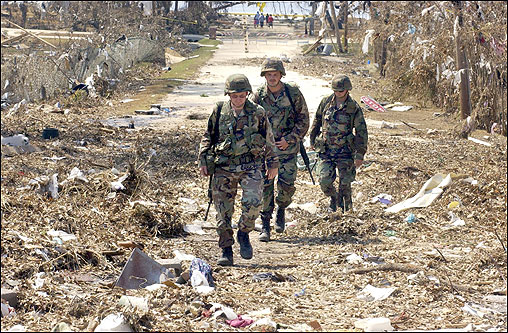 the encampment that he was at before him and all the others were supposed to be bused out of the city to various locations he states, "in this country, I am frequently reminded skin privilege. I have often run through red lights on my bike, right in front of a police care, and the officers never seem to notice or care. In contrast, young Black men in New Orleans have been arrested for riding a bike with one hand, or biking the wrong way down a one-way street. Never had this apartheid treatment felt more real and immediate than on that day in the Causeway camp. My whiteness felt like a uniform I was wearing, one that gave me access to a citizenship denied to the people all around me" and cites a blogger that had a similar experience, mentioning " I still believe that race played a major role. I saw it personally. These National Guard troops were scared to death because of race. The were mostly from rural areas and for them their knowledge of African Americans comes from TV shows like Cops. They pointed guns at many people, and there were plenty of racial slurs." The sense of anomie is unimaginable to me and the implications were clearly unimaginable to Jordan as well, who claims, "I had been aware of crimes committed globally and domestically by the U.S. government, but I was still completely unprepared for what I saw in the evacuee camp. This neglect and abuse went beyond the systemic problems I knew existed. This looked like ethnic cleansing, here, in a
 U.S. city, in the twenty-first century." Also, it is really helpful for those that maybe don't understand the extent that white privilege and race factor into why Katrina played out the way it did with the explanation Jordan gives of his experience. He says, "my intersecting layers of privilege as a journalist and a s white male allowed me to escape and get a comfortable ride. While National Guard soldiers kept watch over others in the camp, they had barely noticed as the three of us walked out. We had resources and connections that may New Orleanians didn't, which meant that for us, a stay in a shelter was never a fear. We had friends and family to stay with in Houston and other nearby cities, and offers of places to stay from around the country." Even when he was effected so greatly by the storm he still realizes, even though it was clearly visible, that he had great privilege over others. Though it helped him get out of the city, there were still many that were left behind. One woman claimed that as bus fulls of people left the crowd got darker and darker. And those that were left behind were framed as crim
 inals. Jordan states "New Orleans's hurricane-ravaged population was transformed by the media into criminals. As if takin a stereo from a store is a greater crime than the governmental neglect and incompetence that did billions of dollars of damage and destroyed a city. This media focus is a deliberate tactic. It works in the same way as a focus during the 1980s on "welfare queens" ans "super-predators" ovscured the simultaneous and larger crimes of the Savings and Loan scams and mass layoffs. The hyper-exploited people of New Orleans are being used as a scapegoat. City, state and national politicians are the real criminals here. Since at least the mid-1800s, the danger faces by flooding to New Orleans has been widely known. The flood of 1927, which, like this week's events, was more about politics and racism than any kind of natural disaster, illustrated exactly the danger faced. Yet government officials have consistently refused to spend the money to protect this poor, majority-Black city." Though of course we did not see this idea that what they were "looting" was not as bad as what the government had done to the citizens and to humans in general. The way they framed the peo
 ple left in the city, gave them the justification for the treatment that they gave. Also, it simply magnified the treatment that they received prior to the storm at a greater magnitude, showing that white lives were valued more than others before and continued after. Jordan claims towards the end of this section of the book that, "in the coming months, billions of dollars will likely flood into New Orleans. This money can either be spent to usher in a "New Deal" for the city, with public investment, creation of stable union jobs new schools, cultural programs and housing restoration, or the city can be "rebuilt and revitalized" to a shell of its former self, whit newer hotels, more casinos, and with chain stores and theme parks replacing the former neighborhoods, cultural centers and corner jazz clubs. Long before Katrina, New Orleans was hit by a hurricane of poverty, racism, disinvestment deindustrialization and corruption. Simply the damage from this pre-Katrina hurricane will take billions to repair." As we can see with instances such as the Jena 6, the path Jordan recommends was not the one taken, yet those that were affected by the hurricane and other injustices in New Orleans, along with many others, have taken great strides to make the city a better place to live (governmental change, etc.).
For me when I realized that there was something wrong, besides seeing that tons of people were stranded in their homes, was when Lil Wayne who I really liked as a 16 year old was seen on the news holding a sign on the side of the road that said something about the injustice (I couldn't find the picture anywhere!), Kanye said George Bush doesn't care about black people, even though I don't love Kanye for being all talk when it comes to justice, and when Tie My Hands and Georgia Bush came out. Obviously, we didn't talk about and were not told the whole story for a reason as we have seen, but this gave another aspect of the story and made me realize that there was clearly something wrong.

You write: "you could see the problems that existed before the storm and how the storm magnified the systems of inequality and how Jordan saw his privilege play out" -- YES; this is key and I think we can say the same about Jena 6; it pointed to the larger issues of inequality and injustice as well the fight for justice
ReplyDelete